





The aim: a full life to the end.
On a cold day a month before Christmas, Yvonne Rowe sat down to write a letter.
Yvonne, who worked as a gardener, made three copies and popped them in a post box – little realising she was planting the seeds of a fund-raising miracle.
Now, those three postage stamps and more than three years later, it has blossomed into a £160,000 phenomenon.
Yvonne, of Thornbury Rise, Darlington, had written to her local papers about the need for a hospice for the terminally ill in the town.
She had a friend suffering from cancer and was inspired by other hospices in England. Previous attempts to launch one in Darlington had come to nothing.
Appalling
Following publication she was swamped by more than 30 letters of support and a public meeting was held in February 1986, organised by the Council for Voluntary Services and chaired by Pam Exelby of the town’s community health council.
The weather conditions were appalling and many people abandoned their cars to walk to the meeting at the Dolphin Centre.
But the determination which got them there has continued to this day. A steering committee was organised and the concept of Darlington and District Hospice Movement was born.
Today the appeal has raised around £160,000, thanks to the generosity of all sections of the community.
Organisers, currently negotiating over council-owned land for a site to house the hospice, estimate the capital costs will add up to £350,000 with annual running costs of about £120,000.
The idea is to build a day-care centre, which will hopefully be open in a year’s time, with the eventual goal of converting it into a 10-bed residential hospice.
But the movement has an important third thrust – a sitting service with 25 volunteers offering relief to carers of the terminally ill in the home.
At present it just operates in the Darlington district but it is hoped to extend soon into Northallerton and Richmond.
In addition the appeal has bought four electronic ‘syringe drivers’, costing £400 each, which administer pain-killing drugs without the patient having to go into hospital.
Milestone
The movement has captured the imagination of Darlington people since its launch and was adopted as this year’s Mayor’s charity.
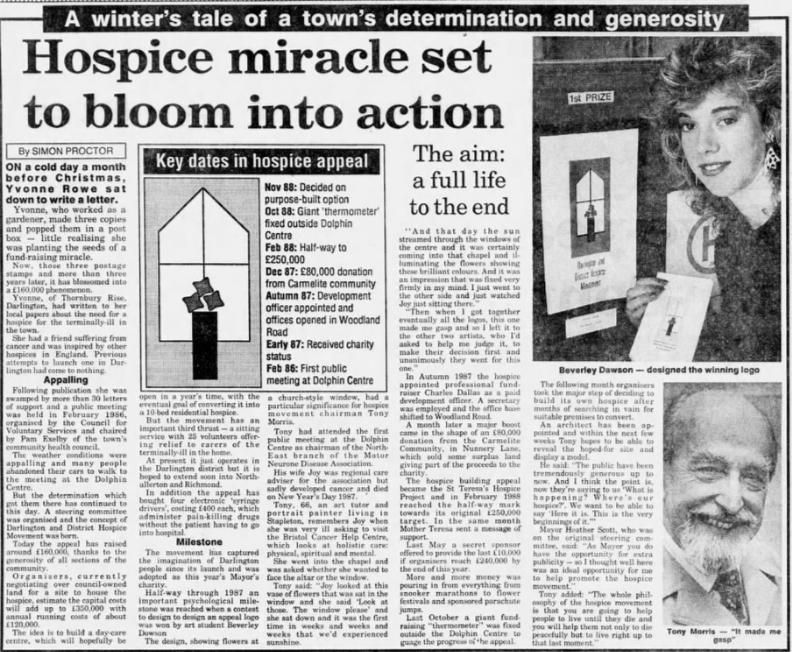
Half-way through 1987 an important psychological milestone was reached when a contest to design an appeal logo was won by art student Beverley Dowson.
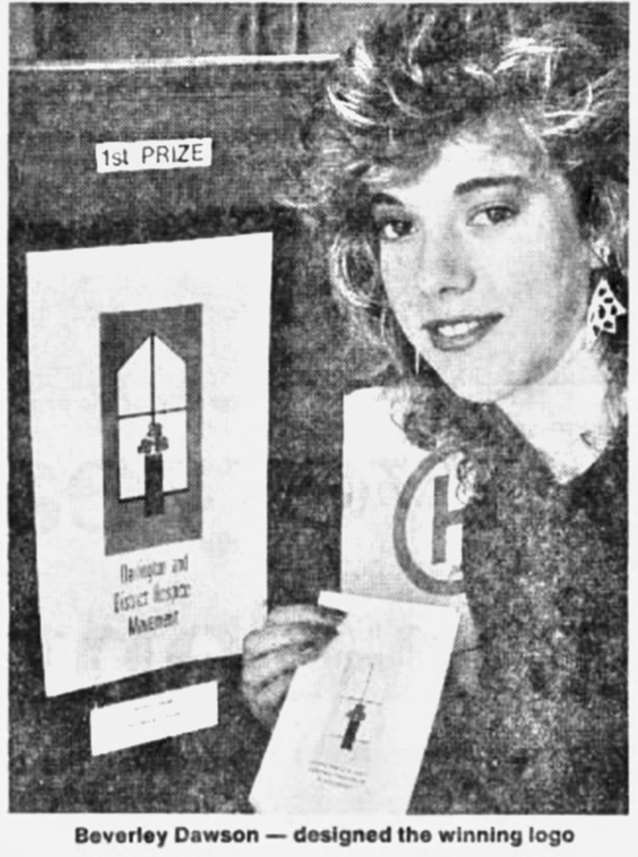
The design, showing flowers at a church-style window, had a particular significance for hospice movement chairman Tony Morris.
Tony had attended the first public meeting at the Dolphin Centre as chairman of the North East branch of the Motor Neurone Disease Association.
His wife Joy was regional care adviser for the association but sadly developed cancer and died on New Year’s Day 1987.
Tony, 66, an art tutor and portrait painter living in Stapleton, remembers Joy when she was very ill asking to visit the Bristol Cancer Help Centre, which looks at holistic care: physical, spiritual and mental.
She went into the chapel and was asked whether she wanted to face the altar or the window.
Tony said: “Joy looked at this vase of flowers that was sat in the window and she said ‘Look at those. The window please’ and she sat down and it was the first time in weeks and weeks and weeks that we’d experienced sunshine.
“And that day the sun streamed through the windows of the centre and it was certainly coming into that chapel and illuminating the flowers showing these brilliant colours. And it was an impression that was fixed very firmly in my mind. I just went to the other side and just watched Joy just sitting there.”
“Then when I got together eventually all the logos, this one made me gasp and so I left it to the other two artists, who I’d asked to help me judge it, to make their decision first and unanimously they went for this one”
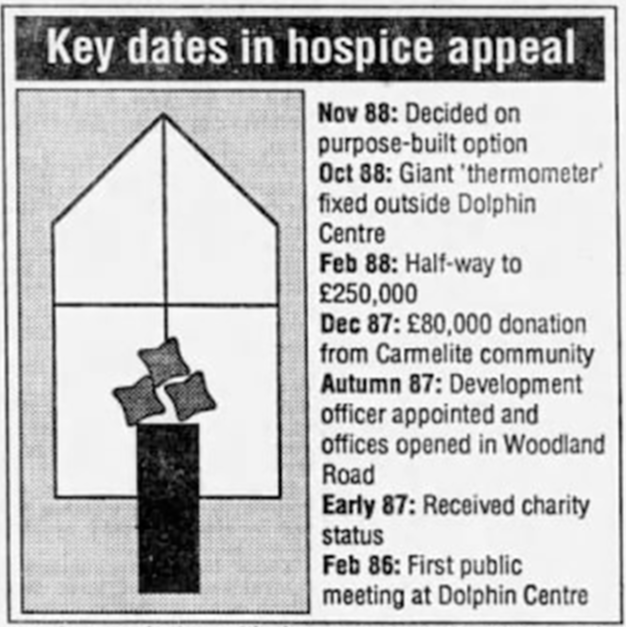
In Autumn 1987 the hospice appointed professional fundraiser Charles Dallas as a paid development officer. A secretary was employed and the office base shifted to Woodland Road.
A month later a major boost came in the shape of an £80,000 donation from the Carmelite Community in Nunnery Lane, which sold some surplus land giving part of the proceeds to the charity.
The hospice building appeal became the St Teresa’s Hospice Project and in February 1988 reached the half-way mark towards its original £250,000 target. In the same month Mother Teresa sent a message of support.
Last May a secret sponsor offered to provide the last £10,000 if organisers reach £240,000 by the end of this year.
More and more money was pouring in from everything from snooker marathons to flower festivals and sponsored parachute jumps.
Last October a giant fundraising “thermometer” was fixed outside the Dolphin Centre to guage the progress of the appeal.
The following month organisers took the major step of deciding to build its own hospice after months of searching in vain for suitable premises to convert.
An architect has been appointed and within the next few weeks Tony hopes to be able to reveal the hoped for site and display a model.
He said: “The public have been tremendously generous up to now. And I think the point is, now they’re saying to us ‘What is happening? Where’s our hospice?’. We want to be able to say ‘Here it is. This is the very beginnings of it.’’’
Mayor Heather Scott, who was on the original steering committee, said: ‘’As Mayor you do have the opportunity for extra publicity – so I thought well here was an ideal opportunity for me to help promote the hospice movement.’’
Tony added: ‘’The whole philosophy of the hospice movement is that you are going to help people live until they die and you will help them not only to die peacefully but to live right up to that last moment.’